
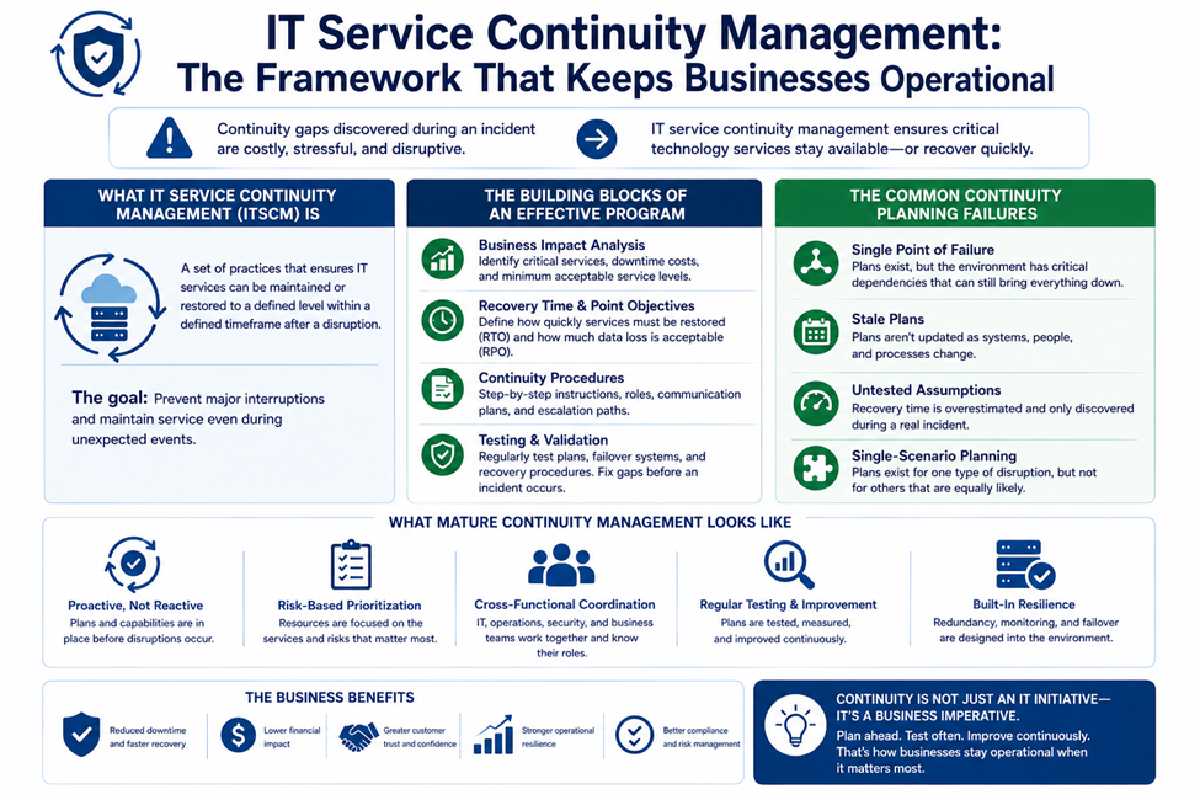
Most businesses discover their continuity gaps during an incident. That’s the worst possible time for the discovery — when the pressure is highest, the information is incomplete, and the people who need to make decisions are already managing a crisis.
The businesses that navigate disruptions well don’t do it by reacting more effectively. They do it by having worked through the scenarios before the incident, built the procedures, tested the responses, and established the muscle memory that allows teams to function under pressure without improvising.
IT service continuity management is the discipline that makes this possible. Understanding what it actually involves — and what distinguishes effective programs from nominal ones — is worth the time for any organization that depends on its technology to operate.
Table of Contents
What IT Service Continuity Management Actually Is
IT service continuity management (ITSCM) is a set of practices designed to ensure that technology services can be restored to a defined level of performance within a defined timeframe after a disruption — or, better, maintained through a disruption without significant degradation.
The framing matters. “Restoring services” is defensive — it assumes the worst has happened and asks how fast you can recover. The more ambitious goal of ITSCM is ensuring that disruptions don’t fully interrupt service delivery in the first place. This requires a different kind of planning: not just recovery procedures, but redundant systems, failover mechanisms, and operational procedures for degraded conditions.
Strong it service continuity management helps organizations maintain operations even during unexpected disruptions — which is a fundamentally different outcome from recovering after operations have stopped.
The Building Blocks of an Effective Program
A functional ITSCM program isn’t a document. It’s a set of maintained capabilities. The components that distinguish effective programs from paper-based ones are worth naming specifically.
Business impact analysis. Before you can plan continuity, you need to understand what you’re protecting. A business impact analysis identifies which IT services are critical, what the cost of losing them is at different time horizons (an hour of downtime versus a day versus a week), and what the minimum acceptable service level is for each. This analysis drives prioritization decisions — where to invest in resilience, what recovery time is acceptable for each service, and what the sequencing of recovery efforts should be.
Recovery time objectives and recovery point objectives. These are the planning parameters that make continuity commitments concrete. The recovery time objective (RTO) specifies how quickly a service must be restored after an outage. The recovery point objective (RPO) specifies how much data loss is acceptable — effectively, how far back in time you can recover from. Both should be set based on business requirements, tested against actual capabilities, and reviewed when business requirements change.
Continuity procedures. The step-by-step documentation of how recovery actually happens: what systems are recovered in what order, who is responsible for each step, what the communication protocols are, and what the escalation path looks like. These procedures should be specific enough to be executed by someone who’s not familiar with every detail of the environment — because during a real incident, the person who knows everything about a system may not be available.
Testing. This is the element most often missing from nominal continuity programs. Plans that have never been tested are hypotheses. They may describe a process that can’t actually be executed in the time assumed, or that depends on a system that was replaced but not updated in the plan, or that conflicts with another procedure in a way that only becomes apparent in practice. Testing surfaces these gaps in controlled conditions where they can be fixed.
The Common Continuity Planning Failures
The failure modes in ITSCM are well-documented, which makes them surprisingly easy to prevent for organizations willing to take the discipline seriously.
The single point of failure problem. Organizations invest in detailed continuity plans and then build environments with single points of failure that the plan can’t compensate for. A comprehensive backup strategy that stores backups on the same network segment as primary data. A disaster recovery site that depends on the same internet provider as the primary site. The plan exists, but the architecture doesn’t support it.
The stale plan problem. Continuity plans are built at a point in time and then the environment changes. New systems are added. Old ones are replaced. Staff changes. The plan isn’t updated. When an incident occurs, the procedures reference systems that no longer exist, contact information for people who’ve left, and recovery sequences that don’t match the actual architecture.
The untested assumption problem. Recovery time objectives are set during planning based on estimates. The estimates seem reasonable. No one tests them. During an actual incident, recovery takes three times as long as the RTO because the actual environment is more complex than the estimate accounted for.
The single-scenario problem. Plans are built for one type of disruption — typically the type that was most recently discussed in a leadership meeting. The ransomware scenario gets planned in detail. The data center fire scenario doesn’t get touched. The supply chain disruption scenario doesn’t exist. Real disruptions don’t follow the scenario that received the most planning attention.
What Mature Continuity Management Looks Like
Organizations with mature ITSCM programs share a few characteristics that distinguish them from those with nominal programs.
They exercise regularly. Tabletop simulations, planned failover tests, and component-level testing happen on a schedule, not just when an audit requires it. The lessons from each exercise are documented and incorporated into updated procedures.
They maintain governance. Someone is accountable for the ITSCM program — not as an additional duty for an already overloaded IT manager, but as an actual responsibility with defined expectations. The program is reviewed on a regular cadence, and changes to the technology environment trigger a review of relevant continuity procedures.
They measure what matters. Recovery time against objective. Recovery point against objective. Number of incidents that activated continuity procedures. Time to detection. These metrics tell the organization whether the program is actually functioning, not just whether a plan document exists.
The purpose of IT service continuity management is to give an organization control over the worst-case scenario instead of being at its mercy. That control is built slowly, through consistent investment in planning, testing, and maintenance. It can’t be acquired in a crisis. It either exists before the disruption or it doesn’t — and the difference in outcomes reflects that.