
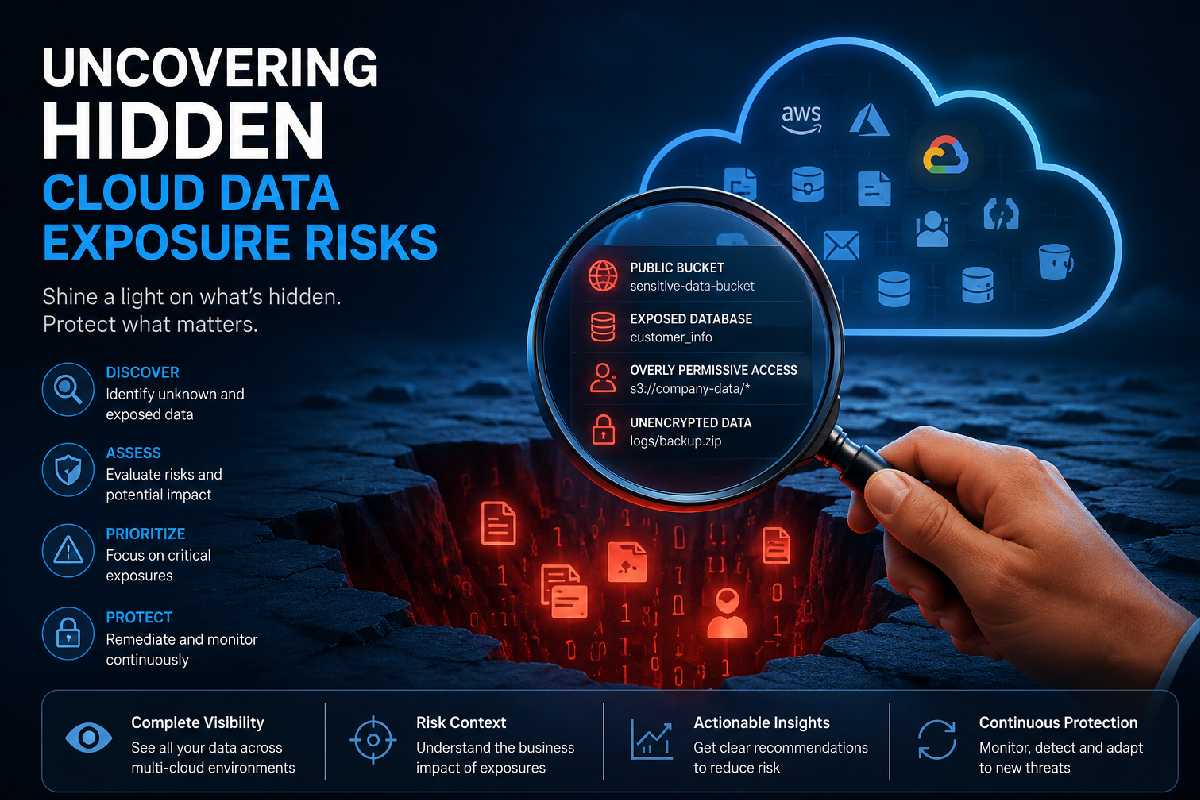
Organizations migrating workloads to the cloud face a growing set of cloud data exposure risks that often remain invisible until a breach occurs. This article examines the most pressing threats, from misconfigurations and inadequate identity and access management to multi-cloud architecture challenges, compliance violations, and proven strategies for data leak prevention.
Table of Contents
Defining the Top Cloud Data Exposure Risks Today
Cloud data exposure risks refer to the conditions, misconfigurations, and security gaps that allow sensitive information stored in cloud environments to be accessed, leaked, or stolen by unauthorized parties. These risks span technical, organizational, and procedural domains, and they multiply as enterprises adopt more cloud services across more providers.
Categories of Exposure Risk
- Configuration drift: Infrastructure settings that deviate from secure baselines over time, often without detection.
- Excessive permissions: Users, service accounts, and applications granted broader access than their roles require.
- Shadow data: Copies of sensitive data created in development, staging, or analytics environments that fall outside governance controls.
- Unencrypted data at rest or in transit: Storage buckets, databases, and API calls that transmit or store information without proper encryption.
- Third-party integrations: SaaS tools and partner connections that extend the attack surface beyond the organization’s direct control.
Why These Risks Stay Hidden
Many cloud data exposure risks persist because traditional security monitoring tools were designed for on-premises networks. They lack the visibility needed to track ephemeral workloads, serverless functions, and dynamically provisioned storage. Without continuous posture assessment, security teams discover vulnerabilities only after attackers exploit them.
Additionally, rapid development cycles and DevOps automation can introduce insecure defaults that bypass manual review. The gap between deployment speed and security review cadence is one of the primary reasons exposure risks accumulate silently across cloud estates.
The Most Common Cloud Security Threats and How They Evolve
Understanding common cloud security threats requires looking beyond static checklists. Attackers continuously adapt their techniques, and the threat landscape shifts as cloud providers introduce new services and features that create novel attack vectors.
Threat Categories That Persist
- Account hijacking: Credential theft through phishing, credential stuffing, or token interception remains a top vector for cloud breaches.
- Insecure APIs: Poorly authenticated or overly permissive APIs expose backend data stores directly to the internet.
- Insider threats: Employees or contractors with legitimate access who misuse or exfiltrate data, whether intentionally or through negligence.
- Supply chain attacks: Compromised container images, open-source libraries, or CI/CD pipeline components that inject malicious code into production environments.
- Ransomware targeting cloud storage: Attackers encrypting cloud-hosted databases and demanding payment, a trend that has accelerated since 2024.
How Threats Evolve in 2026
Attackers increasingly use automation and AI-assisted reconnaissance to scan for exposed cloud assets at scale. Techniques such as automated bucket enumeration, API fuzzing, and lateral movement through interconnected cloud services have reduced the time between initial access and data exfiltration from days to hours.
Cloud-native threats also exploit trust relationships between services. For example, a compromised Lambda function with overly broad IAM permissions can pivot to access S3 buckets, DynamoDB tables, or Secrets Manager entries without triggering traditional network-based alerts. This makes common cloud security threats harder to detect with perimeter-focused tools alone.
How Misconfigurations Become Your Biggest Vulnerability
Misconfigurations consistently rank as the leading cause of cloud data breaches. Research from multiple industry reports confirms that the majority of cloud security incidents trace back to preventable configuration errors rather than sophisticated exploits.
High-Impact Misconfiguration Examples
| Misconfiguration Type | Risk | Real-World Impact |
| Publicly accessible storage buckets | Unrestricted read/write access to sensitive files | Exposed customer records, PII, and intellectual property |
| Disabled logging and monitoring | No audit trail for unauthorized access | Delayed breach detection, often by months |
| Default security group rules | Open ports (e.g., 22, 3389) exposed to 0.0.0.0/0 | Brute-force attacks against management interfaces |
| Unrotated access keys | Long-lived credentials susceptible to theft | Persistent unauthorized access even after personnel changes |
| Missing encryption on database snapshots | Plaintext copies of production data | Data theft from shared or cross-account snapshots |
Root Causes of Persistent Misconfigurations
Misconfigurations persist for several interconnected reasons. Teams frequently use infrastructure-as-code templates copied from public repositories without reviewing security settings. Manual changes made through cloud provider consoles bypass version-controlled configurations, creating drift that goes unnoticed. And the sheer volume of configurable parameters across cloud services – AWS alone offers thousands of individual settings – makes comprehensive manual review impractical.
Automated configuration scanning tools can continuously evaluate infrastructure against security benchmarks like CIS and NIST, flagging deviations before they become exploitable vulnerabilities. Without this kind of continuous assessment, misconfigurations remain the path of least resistance for attackers.
Why Inadequate Identity and Access Management Leads to Breaches
Inadequate identity and access management is one of the most consequential cloud data exposure risks. When organizations fail to enforce the principle of least privilege, every overprivileged account becomes a potential entry point for attackers and a vector for data exfiltration.
Common IAM Failures
- Wildcard permissions: Policies granting broad access (e.g., s3:* or ec2:*) instead of scoping permissions to specific resources and actions.
- Stale accounts: Former employees, decommissioned service accounts, or unused roles that retain active credentials.
- Missing multi-factor authentication: Root accounts and privileged users operating without MFA, leaving them vulnerable to credential compromise.
- Cross-account trust misconfigurations: Overly permissive assume-role policies that allow unintended accounts to access sensitive resources.
The Blast Radius of a Compromised Identity
A single compromised identity with excessive permissions can give an attacker the ability to enumerate resources, download data, modify configurations, and establish persistence – all within minutes. In cloud environments, identity is the new perimeter. Without granular access controls, network segmentation alone cannot contain lateral movement.
Organizations that implement just-in-time access provisioning, continuous permission analysis, and automated revocation of unused entitlements significantly reduce their exposure. Cloud Infrastructure Entitlement Management (CIEM) capabilities, available through platforms like Prisma Cloud, provide the visibility needed to identify and remediate excessive permissions across complex multi-cloud deployments.
Navigating Multi-Cloud & Architecture Challenges in 2026
Most enterprises now operate across two or more cloud providers, and multi-cloud and architecture challenges introduce complexity that directly increases cloud data exposure risks. Each provider has its own security model, naming conventions, permission structures, and default configurations.
Key Architectural Complexity Factors
- Inconsistent security controls: A security group in AWS, a network security group in Azure, and a firewall rule in GCP serve similar functions but are configured differently, increasing the chance of gaps.
- Data residency and sovereignty: Distributing workloads across regions and providers complicates compliance with data localization requirements.
- Fragmented visibility: Security teams often rely on provider-specific dashboards, creating blind spots where cross-cloud attack paths go undetected.
- Interoperability gaps: Connecting services across providers (e.g., AWS Lambda calling a GCP Cloud Function) introduces authentication and encryption handoff points that are frequently misconfigured.
Strategies for Managing Multi-Cloud Complexity
Centralizing security policy management across providers is critical. Organizations should adopt a cloud-native application protection platform (CNAPP) that normalizes security telemetry from AWS, Azure, and GCP into a unified view. This approach eliminates the fragmentation that allows threats to hide in the seams between providers.
Architecture decisions also matter. Using consistent tagging taxonomies, standardized infrastructure-as-code modules, and unified secrets management reduces configuration drift across environments. Teams that treat multi-cloud architecture challenges as a governance problem – not just a technical one – achieve more consistent security outcomes.
The High Cost of Data Exposure and Compliance Violations
The financial and reputational consequences of cloud data exposure extend far beyond the immediate cost of incident response. Compliance violations triggered by data breaches can result in regulatory fines, legal liability, lost customer trust, and long-term revenue impact.
Financial Impact by Category
| Cost Category | Description | Estimated Range |
| Regulatory fines | GDPR, HIPAA, PCI DSS, and state-level privacy law penalties | $100K to $20M+ per incident |
| Breach notification | Legal counsel, customer communication, credit monitoring | $1M to $5M |
| Operational downtime | Revenue loss during investigation and remediation | Varies widely by industry |
| Reputational damage | Customer churn, lost deals, reduced market valuation | Often exceeds direct costs |
| Legal settlements | Class action lawsuits and individual claims | $5M to $100M+ for large breaches |
Compliance Frameworks Most Affected
Cloud data exposure frequently triggers compliance violations across multiple regulatory frameworks simultaneously. GDPR Article 32 requires appropriate technical measures to protect personal data; a misconfigured storage bucket violates this requirement directly. HIPAA’s Security Rule mandates access controls and audit logging for protected health information, and PCI DSS requires encryption of cardholder data both at rest and in transit.
Organizations that proactively map their cloud configurations to compliance requirements – and continuously validate alignment – avoid the costly cycle of breach, investigation, and penalty. Automated compliance monitoring reduces the manual burden on security teams while providing auditable evidence of control effectiveness.
Essential Strategies for Effective Cloud Data Leak Prevention
Data leak prevention in cloud environments requires a layered approach that combines technical controls, process improvements, and organizational accountability. No single tool or policy eliminates all risk, but a well-designed prevention strategy dramatically reduces the likelihood and impact of exposure events.
Technical Controls
- Data classification and discovery: Automatically scan cloud storage, databases, and data lakes to identify and tag sensitive data, including PII, financial records, and intellectual property.
- Data Security Posture Management (DSPM): Continuously discover, classify, and monitor sensitive data across cloud and SaaS environments to identify exposures and prioritize remediation faster.
- Encryption enforcement: Require encryption at rest and in transit for all data stores, with key management policies that prevent unauthorized decryption.
- Network segmentation: Isolate sensitive workloads using VPCs, private subnets, and service endpoints that restrict data flow to authorized paths.
- Data loss prevention (DLP) policies: Implement content inspection rules that detect and block unauthorized transfers of sensitive data through email, file sharing, or API calls.
Process and Governance Controls
- Shift-left security: Integrate security scanning into CI/CD pipelines so that misconfigurations and exposed secrets are caught before deployment.
- Regular access reviews: Conduct quarterly reviews of user permissions, service account entitlements, and cross-account trust relationships.
- Incident response planning: Maintain and test cloud-specific incident response runbooks that address data exposure scenarios across each provider.
- Security awareness training: Educate developers and operations staff on secure cloud configuration practices and the consequences of data exposure.
Effective data leak prevention is not a one-time project. It requires continuous refinement as cloud environments grow and new services are adopted. Organizations that embed prevention into their operational workflows rather than treating it as a periodic audit activity achieve measurably better outcomes.
How Exposure Risks Differ Across AWS, Azure, and GCP
Each major cloud provider implements security differently, and understanding provider-specific nuances is essential for managing cloud data exposure risks effectively. What constitutes a secure configuration in one platform may not translate directly to another.
AWS-Specific Exposure Risks
Amazon Web Services presents unique risks through its extensive service catalog. S3 bucket policies and ACLs operate as separate permission layers, and conflicts between them can inadvertently expose data. IAM policies in AWS support complex condition keys that, when misconfigured, can grant broader access than intended. Additionally, AWS Lambda execution roles frequently accumulate permissions over time as developers add access for new integrations without removing unused entitlements.
Azure-Specific Exposure Risks
Microsoft Azure’s integration with Active Directory introduces exposure vectors tied to hybrid identity configurations. Misconfigured Azure AD conditional access policies can allow unmanaged devices to access sensitive resources. Azure Blob Storage shared access signatures (SAS tokens) with overly long expiration periods or excessive permissions are a recurring source of data leaks. Role-Based Access Control (RBAC) inheritance through Azure’s management group hierarchy can also propagate excessive permissions downward without administrators realizing the scope.
GCP-Specific Exposure Risks
Google Cloud Platform’s project-based resource model creates risks when IAM bindings are applied at the organization or folder level, granting unintended access across multiple projects. BigQuery datasets with public access enabled have been a documented source of large-scale data exposure. GCP’s default service account, which is automatically attached to Compute Engine instances, often carries the Editor role – a level of access far beyond what most workloads require.
Security teams managing multi-cloud environments must develop provider-specific expertise or adopt tools that abstract these differences into a normalized security model.
Tools and Technologies to Mitigate Exposure
A growing ecosystem of cloud security tools addresses different facets of data exposure risk. Selecting the right combination depends on an organization’s cloud footprint, regulatory requirements, and security maturity.
Core Tool Categories
| Tool Category | Function |
| Cloud Security Posture Management (CSPM) | Continuous misconfiguration detection and compliance monitoring |
| Cloud Infrastructure Entitlement Management (CIEM) | Permission analysis, least-privilege enforcement |
| Data Security Posture Management (DSPM) | Sensitive data discovery, classification, and flow mapping |
| Cloud Workload Protection Platform (CWPP) | Runtime threat detection for VMs, containers, and serverless |
| Infrastructure as Code (IaC) Scanning | Pre-deployment configuration validation |
Convergence Toward CNAPP
The industry trend toward cloud-native application protection platforms (CNAPP) reflects the need to consolidate these capabilities into a unified solution. Organizations evaluating tools should prioritize platforms that offer agentless scanning for broad coverage, agent-based protection for deep runtime visibility, and API-based integration with existing DevOps workflows. The ability to correlate findings across these data sources is what separates effective platforms from collections of disconnected features.
Building a Resilient Cloud Security Posture
Resilience in cloud security means maintaining strong defenses even as environments change, teams scale, and new threats emerge. A resilient posture is not a static achievement but a continuous operational discipline.
Foundational Principles
- Assume breach: Design architectures and access controls under the assumption that any component could be compromised. This mindset drives segmentation, encryption, and monitoring decisions.
- Automate enforcement: Replace manual security reviews with automated guardrails that prevent insecure configurations from reaching production. Policy-as-code frameworks ensure consistency at scale.
- Measure and improve: Track metrics such as mean time to detect (MTTD), mean time to remediate (MTTR), and the number of critical misconfigurations over time. Use these metrics to identify systemic weaknesses.
Organizational Alignment
Technical controls alone are insufficient without organizational alignment. Security, development, and operations teams must share responsibility for cloud security outcomes. This requires clear ownership models where each team understands which controls they are accountable for and how their work affects the overall risk posture.
Continuous Improvement Cycle
A resilient cloud security posture follows a continuous improvement cycle: assess the current state, identify gaps against a defined framework (such as the NIST Cybersecurity Framework or CIS Controls), implement remediations, validate effectiveness, and reassess. Organizations that formalize this cycle – and allocate dedicated resources to it – consistently outperform those that treat cloud security as an ad hoc activity.
Integrating threat intelligence feeds and participating in industry information-sharing communities further strengthens resilience by ensuring that defenses evolve in response to real-world attacker behavior rather than theoretical risks alone.