
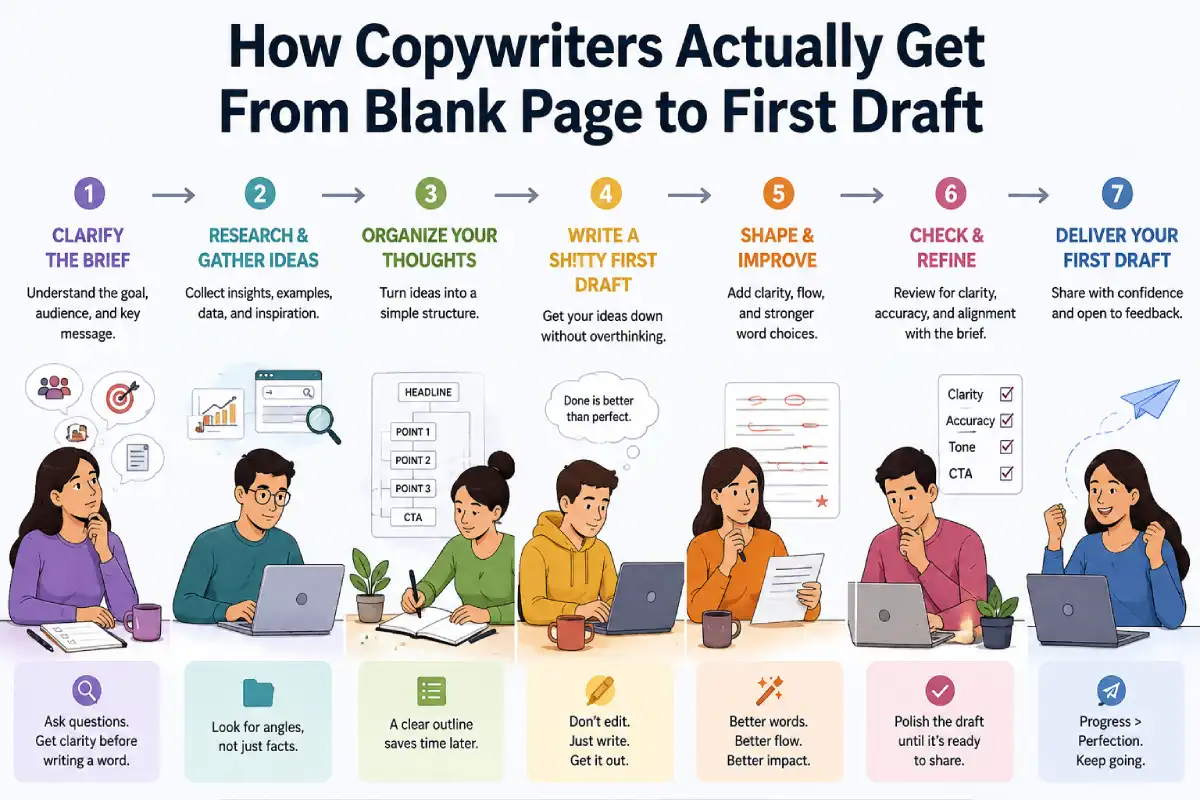
Getting words onto the page is often the hardest part of a copywriter’s job, harder than the editing that follows once something exists to work with. A blank document carries a pressure a half-finished one doesn’t, because every option is still open and nothing yet proves the writer can pull the piece off. That pressure shows up in experienced copywriters as much as beginners, since deadlines and an unsettled brief can stall the process before a sentence lands.
What separates copywriters who move through this stage quickly from those who stay stuck isn’t talent so much as habits that lower the stakes of starting. Rather than treating a first draft as a performance that has to go right, working copywriters break the task into smaller, messier steps that get something usable on the page without demanding it be good yet. What follows looks at what those steps involve, from the first messy capture of an idea to where editing can safely begin.
Table of Contents
Procrastination usually comes from fear, not laziness
Putting off a piece of writing rarely means someone would rather be doing something else. More often, the delay comes from worrying the finished piece won’t be good enough, and staying away from the page keeps that judgement at arm’s length. Writers and Artists, the industry resource run by Bloomsbury, makes the point that most early writing is genuinely not very good, which is normal rather than a sign the project is doomed. Naming the fear takes some of its power away, turning an abstract dread into an ordinary problem every writer deals with.
Building a fixed time and place to write helps for the same reason a regular gym session does, since removing the daily decision of whether to start removes one excuse to delay. Copywriters who treat a first draft as a scheduled appointment rather than something to fit in when inspiration strikes tend to produce more consistent work, simply because they show up often enough for good days to outnumber bad ones.
Capturing rough ideas before they disappear keeps momentum going
Good lines and useful structure often show up at inconvenient moments, on a commute or halfway through a shower, long before a laptop is nearby. Writers who wait until they’re at a desk to capture these thoughts usually lose the sharpest version of the idea, left with a vaguer memory of having had a good one. Some copywriters now talk a rough draft into existence rather than typing from a blank page, using dictation software from Voice Technologies to get spoken thoughts down while the phrasing is fresh, often in a more natural, conversational tone than typing produces.
This suits copywriters, since commercial writing is meant to sound like one person talking to another rather than formal prose. A voice memo recorded on the way to a meeting can become the backbone of an email sequence once tidied up, saving the writer from reconstructing that clarity at a keyboard hours later.
Starting with a question works better than starting with a perfect sentence
Chasing a strong opening line before anything else exists on the page usually backfires, since it asks the hardest sentence to also be the first one written. A more workable starting point is a plain question about the piece itself, such as what the reader needs to understand by the end, or what single idea the draft is meant to support. Answering that in a few rough lines gives the writer something to react to, and reacting to existing words is far easier than generating them from nothing.
Published authors asked about their own process circle back to a similar idea, that focusing on process rather than product matters more than getting a piece right first time, and that stepping away to something unrelated often does more for a stuck opening than staring at the screen. Client requirements and tone of voice can be handled once there’s a rough draft to shape, but none of that matters if the page stays empty because the writer tries to solve every problem in one sentence.
A scrappy structure beats a blank page every time
Bullet points, half-sentences and a rough running order do more to unblock a stuck project than staring at an empty document ever will. Sketching what each section needs to cover, even in a single line per point, turns the task from inventing a whole piece at once into filling gaps one at a time, a far less intimidating way through a long brief. Many copywriters build this scaffold before writing a full sentence, treating the outline itself as the first real progress.
Once a rough shape exists, the order of writing doesn’t have to match the order the reader will see, so a copywriter stuck on an opening can skip it and write the section they already have a clear idea for. Coming back to the opening later is usually far easier, since there’s an actual draft to introduce rather than a blank page trying to summon one from nothing.
Editing separately from drafting stops both jobs interfering with each other
Trying to write a clean sentence and judge whether it’s any good at the same time slows almost every writer down, since the two tasks pull attention in opposite directions. Building in a real gap between finishing a draft and editing it, even just an evening or a coffee break, gives enough distance to spot what needs fixing. Editing straight after drafting tends to catch the same surface issues while missing the bigger structural ones, since the writer is still too close to the choices just made.
Copywriters who blend drafting and editing into one pass tend to spend far longer on a piece than the writing should take, since every sentence gets rewritten before the next is attempted. Separating the two stages, even loosely, means the draft can stay rough and honest about what still needs work, while the edit that follows has something real to sharpen rather than a handful of overworked paragraphs.
Most copywriters who consistently hit deadlines aren’t the ones with a special talent for opening lines, but the ones who’ve built a reliable way past the blank page without waiting for the perfect moment. Treating a first draft as scaffolding rather than a finished product speeds up the whole process, and often produces better final copy too, simply because there was something worth editing sooner.