
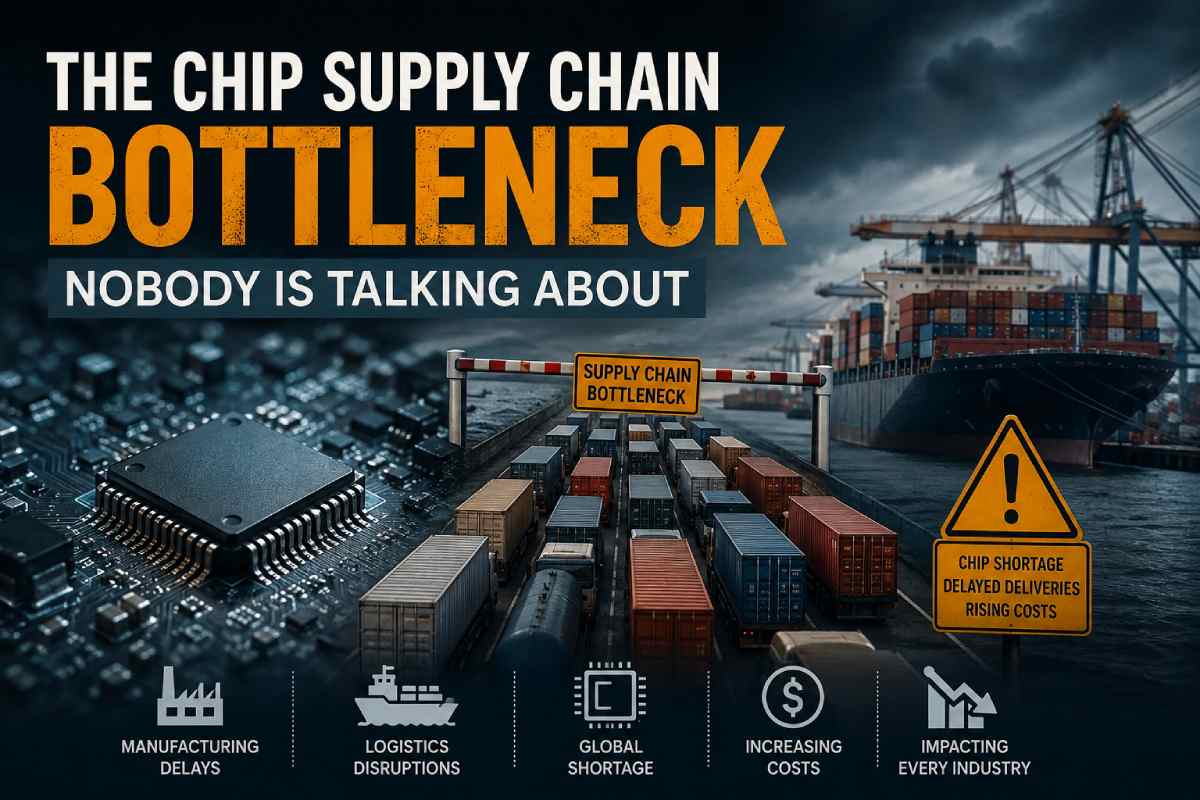
Every conversation about AI hardware scarcity eventually lands on the same two names: TSMC and Nvidia. That framing is not wrong, but it is incomplete, and it is starting to hide a more interesting bottleneck further down the chain that gets a fraction of the attention it deserves — advanced packaging.
Modern AI accelerators are not single dies anymore. They are stacks of compute and high-bandwidth memory bonded together using techniques like CoWoS and other 2.5D and 3D packaging methods, which physically join multiple silicon components into a single finished chip. That packaging capacity, not raw wafer output, is increasingly the constraint that determines how many finished accelerators actually reach customers. A foundry can have wafers ready and fully processed, and a customer can still wait months for a shippable chip, because the packaging step that turns a finished wafer into a usable product is booked out for quarters at a time.
This matters because packaging capacity is far less flexible than fab capacity, and the industry built its expansion plans around the wrong assumption. Building a new leading-edge fab is a multi-year, multi-billion-dollar undertaking that at least a handful of companies globally know how to execute, and everyone in the industry has internalized that timeline. Building out advanced packaging capacity at the same pace requires an equally specialized, and in some ways even more concentrated, supplier base — one that spent the last decade sized for a demand curve that looks nothing like the one AI has created. Expansion plans that were drawn up assuming steady, incremental demand are now being redrawn assuming demand that keeps surprising to the upside every single quarter.
The knock-on effects are visible in how AI hardware roadmaps get communicated to customers today. Delivery timelines increasingly come wrapped in more hedging language than they did two years ago, with vendors quietly building in buffer that would have looked absurdly conservative in 2023. Meanwhile, the companies that secured long-term packaging capacity commitments early — often through multi-year prepayment agreements that looked risky at the time they were signed — are gaining a competitive advantage that has nothing to do with their chip design and everything to do with supply chain foresight.
There is also a geographic dimension to this that gets underdiscussed. Advanced packaging capacity is even more geographically concentrated than wafer fabrication, which means the same geopolitical risks that dominate conversations about fab location are arguably more acute one step further down the chain. A disruption at a single packaging facility can bottleneck output from multiple fabs simultaneously, in a way that a disruption at any single fab cannot, since packaging sits downstream of many different wafer sources feeding into a comparatively small number of finishing sites.
Diversification efforts are underway, but they move slowly by nature. New packaging facilities being built outside the traditional geographic concentration are years away from meaningful volume, and qualifying a new packaging partner for a leading-edge accelerator is itself a lengthy process involving extensive reliability testing that cannot be rushed without risking yield problems downstream. In the meantime, the handful of existing packaging providers effectively hold pricing power over a much larger and more fragmented set of chip designers competing for their limited capacity, a dynamic that shows up in margin structures throughout the industry even when it never appears explicitly in a press release.
Edgewisely’s ongoing chip coverage has tracked how this shift is reshaping vendor relationships across the AI hardware stack, and it is worth watching closely which companies are quietly locking in packaging supply years in advance versus those still negotiating quarter to quarter and absorbing whatever allocation is left over once larger customers have taken their share.
This dynamic is also reshaping competitive positioning among chip designers in ways that have nothing to do with architecture. A company with a genuinely superior chip design can still lose ground to a competitor with a merely adequate design if that competitor secured packaging capacity years earlier, because the market ultimately rewards whoever can actually ship product at volume, not whoever has the best specifications on paper. Edgewisely’s reporting on one chip maker’s long-term strategy to compete on this front illustrates how much of the real competitive battle in AI hardware is now being fought years in advance, through supply agreements that rarely make headlines at the time they are signed.
For enterprise buyers trying to plan AI infrastructure budgets and timelines, the practical takeaway is to stop treating “chip availability” as a single number pulled from a vendor’s marketing material. Ask suppliers specifically about packaging lead times, not just wafer allocation, and treat the two as genuinely separate constraints rather than a single bottleneck with one name attached to it. It is also worth building longer lead times into procurement planning than internal finance teams typically default to, since a budget cycle built around a quarterly cadence does not match well against a supply chain that is increasingly planning multiple years out.
The two numbers, wafer allocation and packaging capacity, are diverging further every quarter, and the gap between them is where a meaningful share of the real scarcity in AI hardware is currently hiding, largely out of view of anyone who is not asking the right question at the procurement stage rather than after a delivery date has already slipped.