
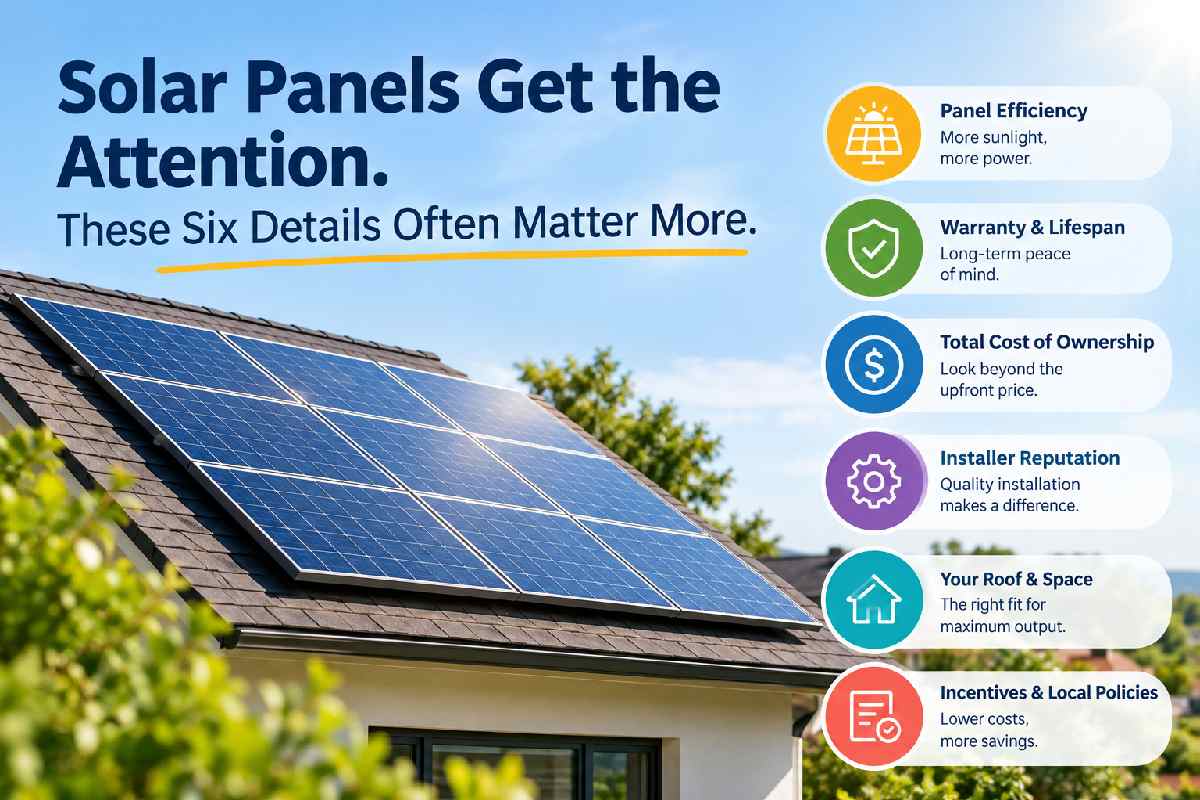
Panel efficiency is one of the easiest solar numbers to compare. It is printed on spec sheets, appears in advertisements, and seems to offer a simple answer: higher must be better. But a residential solar system is not a laboratory test. It has to work on a particular roof, through years of weather, utility changes and ordinary household life.
That is why a slightly less efficient panel in a well-designed system can be a better investment than a premium panel attached to the wrong inverter, placed poorly on the roof or backed by assumptions that never match reality.
Table of Contents
1. Start With the Roof, Not the Panel
A homeowner can buy an excellent panel and still end up with disappointing production if the roof works against the design. Orientation, shade, usable surface area, roof age and obstructions such as vents all affect what can actually be installed.
Before comparing brands, homeowners should understand the physical limits of their own property. A practical residential solar guide can help frame those questions before equipment specifications start driving the conversation.
2. Inverter Architecture Changes the System
Panels produce DC electricity; the inverter system makes that electricity usable in the home. That makes inverter architecture a central design decision, not a footnote.
String inverters can be straightforward and cost-effective. Microinverters and systems using optimizers may offer advantages where roofs have multiple orientations or uneven shading. There is no universal winner. The important question is whether the inverter design matches the roof and whether the homeowner understands what happens if a component fails.
3. Production Estimates Deserve Scrutiny
A sales proposal can look precise because it includes an annual kilowatt-hour estimate. Precision, however, is not the same as certainty.
Ask what assumptions sit behind the estimate. How was shade modeled? What weather data was used? What system losses were included? Does the proposal assume that nearby trees stay exactly as they are? A useful estimate should be explainable in plain language rather than treated as a guaranteed outcome.
4. Warranties Are More Than a Number of Years
A 25-year warranty sounds reassuring, but the duration is only the beginning. Homeowners should distinguish among product, performance and workmanship coverage and understand who is responsible for each one.
Also consider the practical side: Who handles a claim? Is labor included? What happens if the installer is no longer operating? A long warranty has limited value if using it becomes expensive or confusing.
5. Think About Batteries Before You Need One
Not every solar household needs storage on day one. Still, homeowners who may add a battery later should ask whether today’s equipment and electrical design make that straightforward.
Storage goals also matter. A homeowner trying to keep a refrigerator, lights and internet running during an outage has a different requirement from someone expecting to operate most of the house overnight. Battery compatibility should therefore be discussed in terms of actual loads, not just battery capacity.
6. Compare the Whole Economic Picture
The cheapest proposal is not automatically the best value, and the most expensive equipment is not automatically the safest choice. Compare installed cost, expected production, financing terms, equipment, service responsibilities and realistic maintenance exposure.
Homeowners comparing solar system options should also separate equipment performance from financing. A low monthly payment can hide a long loan term or other costs that make two seemingly similar proposals very different.
A Better Question Than “Which Panel Is Best?”
The better question is: Which complete system makes sense for this house and this homeowner?
Panel efficiency matters, especially where roof space is limited. But it is only one variable. Roof conditions, inverter architecture, realistic production modeling, warranty support, storage plans and total economics determine whether the system still looks sensible years after installation.
A good solar proposal should survive questions. If a salesperson cannot clearly explain why a particular design fits the property, another percentage point of panel efficiency will not solve the underlying problem.