
Table of Contents
From Recording Accidents to Preventing Them
As fleet safety technology moves toward 2026, one shift is becoming impossible to ignore: the industry is no longer focused on recording accidents—it’s focused on preventing them.
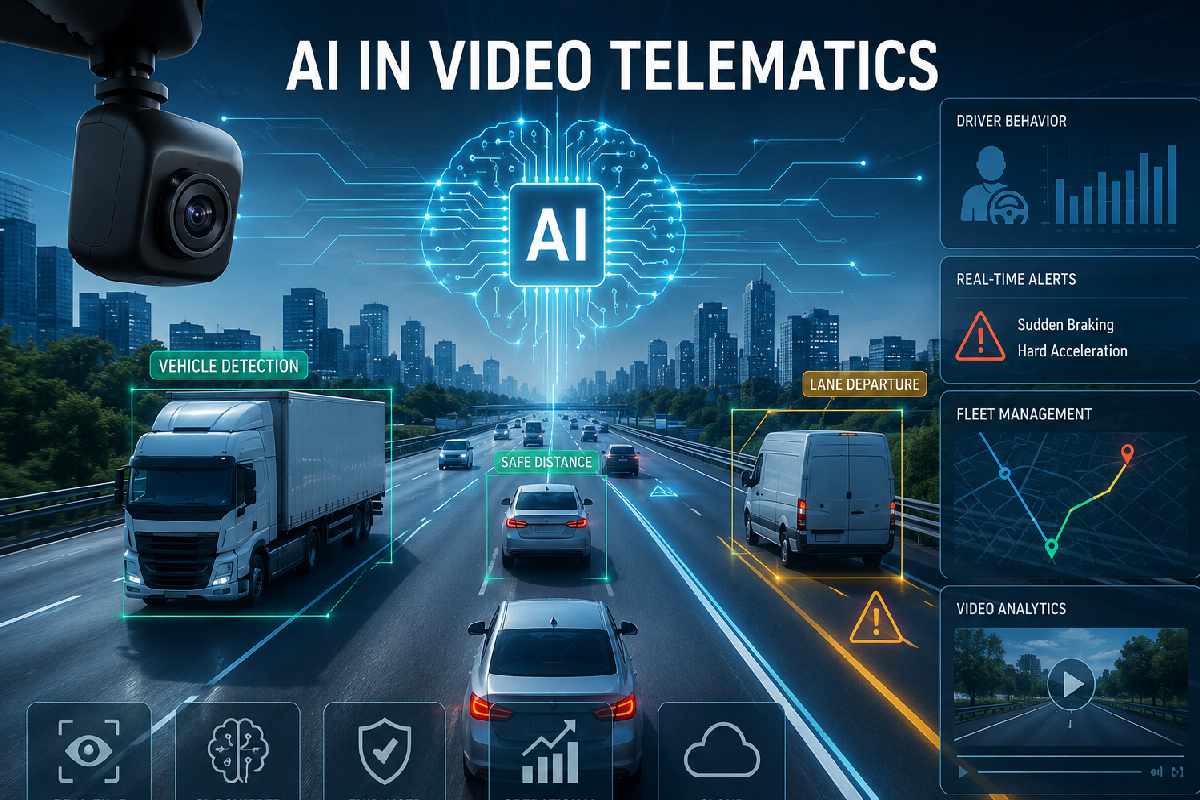
This transformation is driven by AI in video telematics, where the smart dash cam evolves from a passive recording device into an active safety system. Instead of simply capturing footage for post-incident review, AI-powered video telematics continuously analyzes driver behavior and road conditions to identify risk in real time—before incidents occur.
For modern fleets, prevention is no longer optional. It is the foundation of safer operations, lower costs, and long-term scalability.
How AI in Video Telematics Enables Automated Driver Risk Detection
At the core of AI in video telematics is Edge AI—processing intelligence embedded directly inside the smart dash cam.
Unlike traditional video telematics systems that rely on cloud analysis after an event, Edge AI allows driver risk detection to happen locally and instantly. This means faster alerts, reduced data usage, and reliable performance even in areas with limited connectivity.
In practice, automated driver risk detection works through two complementary layers: internal driver monitoring and external road monitoring.
Internal Monitoring: AI-Powered Driver Risk Detection Inside the Cabin
Human factors—fatigue, distraction, and unsafe behavior—account for most road accidents. AI in video telematics directly addresses this challenge through intelligent in-cabin monitoring.
A dual-facing smart dash cam uses infrared sensors and AI vision models to track driver behavior in real time. The system can automatically detect:
- Drowsiness – eyelid closure patterns, yawning frequency, and head nodding
- Distraction – eyes-off-road behavior and mobile phone usage
- Policy violations – smoking, seatbelt non-compliance, or unsafe posture
When risky behavior is identified, the AI-powered dash cam delivers an instant audible alert, prompting the driver to self-correct before the situation escalates. This immediate feedback loop is a critical advantage of AI-driven driver risk detection.
External Monitoring: ADAS Integration in AI Video Telematics
Beyond the cabin, AI in video telematics integrates Advanced Driver Assistance Systems (ADAS) to monitor the road ahead continuously.
Using computer vision and real-time calculations of speed, distance, and lane position, ADAS-enabled smart dash cams provide proactive warnings such as:
- Forward Collision Warnings – alerts when closing speed to the vehicle ahead becomes dangerous
- Lane Departure Warnings – detecting unintended lane drift
- Pedestrian Detection – identifying vulnerable road users in complex urban environments
By combining internal driver monitoring with external road awareness, AI-powered video telematics transforms the dash cam into an intelligent co-driver—one that never gets tired or distracted.
Why AI Is the Future of Fleet Safety Technology
Traditional dash cameras tell fleets what happened.
AI in video telematics tells fleets what is about to happen—and how to prevent it.
This shift from reactive evidence collection to proactive risk management is why AI-driven systems are rapidly becoming the standard for modern fleet safety technology.
Key benefits include:
- Fewer accidents and injuries
- Reduced vehicle repair costs and downtime
- Stronger compliance with safety policies
- Measurable ROI from data-driven driver coaching
For fleet operators, AI-powered driver risk detection is no longer a “nice to have”—it is a competitive advantage.
The AI Feedback Loop That Transforms Fleet Safety Culture
The real value of AI in video telematics goes beyond hardware. It lies in the continuous feedback loop that reshapes driver behavior and fleet culture over time.
Each detected risk follows a clear process:
- Detection – the AI identifies risky behavior, such as tailgating or distraction
- Correction – the driver receives an immediate alert from the smart dash cam
- Analysis – the event is uploaded to a fleet management dashboard
- Coaching – managers use real video clips for targeted, data-backed coaching
This closed loop turns isolated incidents into learning opportunities, steadily improving safety performance across the entire fleet.

Frequently Asked Questions
How does AI in video telematics reduce fleet operating costs?
By improving driver risk detection, fleets experience fewer accidents and less unplanned downtime. This leads to lower repair expenses, improved vehicle utilization, and often reduced insurance premiums tied to safer driving records.
Can a smart dash cam work in remote or low-connectivity areas?
Yes. Next-generation fleet safety technology supports hybrid connectivity. Devices such as the Queclink CV5000 perform AI processing locally and can transmit critical alerts via satellite when cellular networks are unavailable.
Does AI video telematics record everything the driver does?
No. To protect privacy, most AI-powered dash cams use event-triggered recording. The system continuously analyzes risk but only stores and uploads video when a defined safety threshold—such as harsh braking or distraction—is met.
Ready for the Next Era of Fleet Safety?
AI in video telematics is redefining what fleet safety technology can achieve—shifting the focus from visibility to prevention, and from raw data to real-world action.
Explore our latest smart dash cams and discover how AI-driven driver risk detection can deliver zero-blind-spot visibility, wherever your fleet operates.