
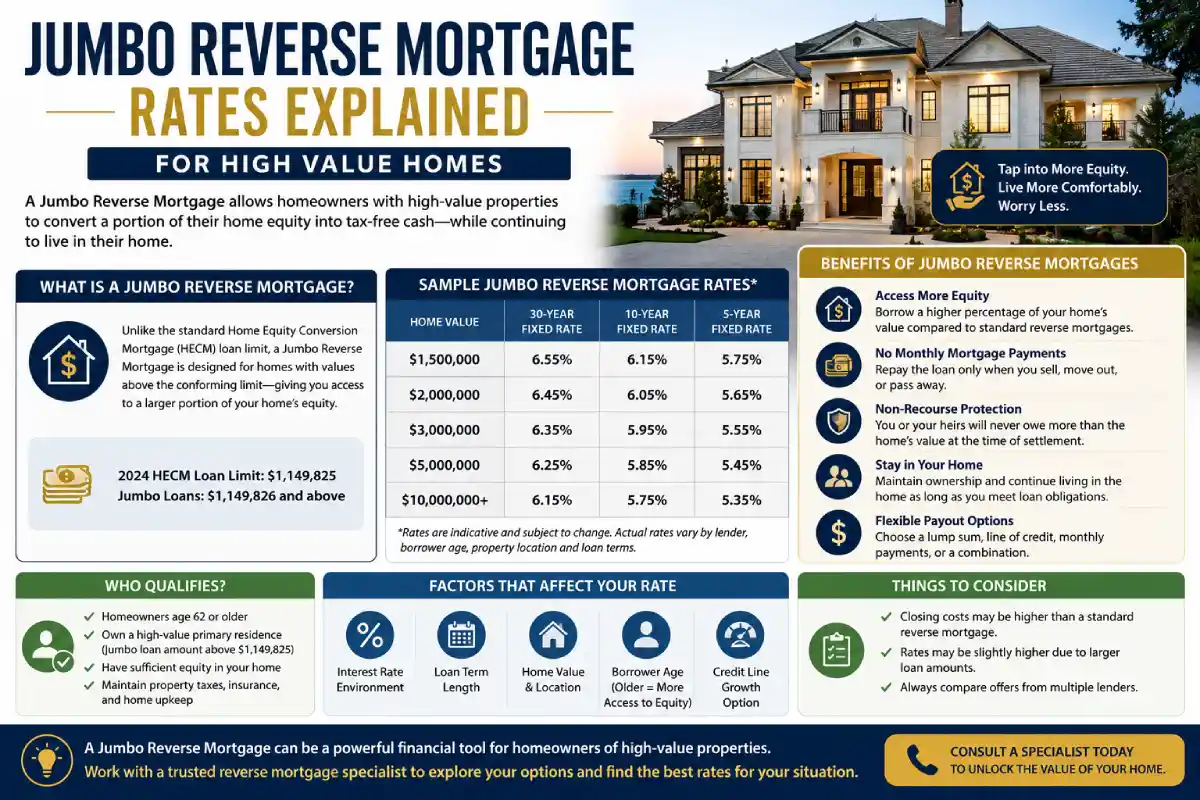
Owning a high-value home can feel like holding a treasure chest that is full, solid, and reassuring, yet strangely hard to open when cash flow gets tight. You may be living in a beautiful property, surrounded by the memories you built there, while also wondering how to turn that value into financial breathing room without selling the place you love. That is exactly where a jumbo reverse mortgage enters the conversation.
For many homeowners with higher-priced properties, traditional reverse mortgage limits may not go far enough. That gap often leads people to explore reverse mortgage jumbo loans, which are designed for homes whose values exceed standard lending caps. But rates, costs, and long-term impact can feel confusing at first glance. And when the numbers are tied to your home, confusion can quickly become emotional.
This guide walks you through how these rates work, what influences them, and what you should weigh before moving forward.
Table of Contents
What Makes a Jumbo Reverse Mortgage Different?
A jumbo reverse mortgage is a private, proprietary reverse mortgage created for homeowners with high-value homes. Unlike government-insured options, these loans are offered by private lenders and can allow you to access a larger portion of your home equity.
That matters if your property value is well above the lending limit for standard reverse mortgage programs. In expensive housing markets, that is often the case. You may have spent decades building equity, only to discover that a conventional reverse mortgage does not fully reflect your home’s worth. That can feel frustrating, even unfair.
Jumbo products aim to close that gap. They can provide larger loan amounts, but they also come with lender-specific rules, qualifications, and pricing. Because they are not standardized in the same way as federally backed programs, rates and terms can vary more widely. That means comparison shopping is not just helpful. It is essential.
How Jumbo Reverse Mortgage Rates Are Set
Rates on these loans are shaped by several moving parts. The first is the broader interest rate environment. When market rates rise, borrowing generally becomes more expensive. When they fall, terms may become more attractive. But that is only the beginning.
Lenders also look at your age, your home’s appraised value, the amount of equity you have, and how you plan to receive funds. Some borrowers choose a lump sum. Others prefer monthly payments, a line of credit, or a mix of options. Each structure can affect pricing.
There is also lender risk. Since these are proprietary loans, lenders build their own pricing models. One lender may offer a lower rate but charge higher fees. Another may advertise flexibility while limiting payout options. That is why the “best” rate is not always the one that looks lowest on paper.
Years ago, a family friend delayed a major financial decision because she wanted to defer action until the “perfect” moment arrived. That moment never really came, and the costs around her changed while she waited. The lesson was gentle but unforgettable: sometimes it is wise to pause, but it is even wiser to understand what waiting may cost you.
Understanding Fixed vs. Variable Rates in Reverse Mortgage Jumbo Loans
When reviewing jumbo reverse mortgage-lenders, you may come across both fixed and variable rate structures. This difference matters more than many homeowners realize.
A fixed rate offers predictability. The interest rate stays the same over time, which can make planning easier and reduce stress. If you value stability and want fewer surprises, this can feel comforting.
A variable rate, on the other hand, can change based on a financial index plus a lender margin. That may start lower than a fixed rate, but it can rise later. For some borrowers, that flexibility is worth considering. For others, uncertainty creates too much anxiety.
There is a deeply human side to this. Many people are not just comparing percentages. They are comparing sleep quality. They want to know whether they will feel secure five or ten years from now. That emotional reality should not be ignored.
The Key Factors That Influence Your Costs
Beyond the interest rate itself, several other costs shape the full picture. Origination fees, servicing fees, appraisal charges, and closing costs can all affect how much equity you ultimately access.
Home value plays a major role. In high-value properties, the appraisal needs to support the numbers being discussed. If the valuation comes in lower than expected, available proceeds may shrink. Property condition matters too. Lenders want to know the home is being maintained.
Borrower age is also important. In general, older borrowers may qualify to access more of their equity because actuarial expectations affect how these loans are structured.
There is a story that captures why emotional clarity matters here. A homeowner once sat at a kitchen table, papers spread everywhere, asking whether the offer in front of him was truly fair. He did not want flattery. He wanted someone to validate his concerns. And that changed everything. Once his questions were taken seriously, the decision became less intimidating. You deserve that same respect from any lender or advisor you speak with.
How to Compare Offers Without Feeling Overwhelmed
The smartest way to compare offers is to look beyond marketing language. Ask each lender for the interest rate, annual percentage rate, total estimated fees, payment options, and any limits on future draws.
Pay attention to how clearly they explain the loan balance growth over time. Since interest accrues on the amount borrowed, plus financed costs in some cases, your balance can increase steadily. That does not automatically make the loan a bad choice, but it does mean transparency matters.
One small image stays with us here: a borrower once glanced around a lender’s office with a furtive expression, almost embarrassed to ask basic questions. That hesitation is more common than people admit. But there is nothing foolish about asking for plain-English answers. In fact, it is one of the strongest financial moves you can make.
Are Reverse Mortgage Jumbo Loans Right for You?
These loans can be powerful tools for the right homeowner. They may help cover healthcare expenses, supplement retirement income, eliminate an existing mortgage payment, or simply provide more flexibility in a stage of life where flexibility feels priceless.
Still, they are not for everyone. If preserving as much home equity as possible for heirs is your top priority, or if you may move in the near future, other options might make more sense. The right decision depends on your goals, your timeline, and your comfort with the tradeoffs.
A jumbo reverse mortgage can create relief, confidence, and breathing room when used thoughtfully. For owners of high-value homes, it may unlock possibilities that standard programs cannot.
When you understand the rates, compare lenders carefully, and ask every question on your mind, the process becomes far less mysterious. And when the mystery fades, something powerful happens. You stop feeling trapped by your home’s value and start seeing how it can support the life you want to live now.